
Cricket, often called “the gentleman’s game,” transcends mere sport in many parts of the world; it’s a religion, a passion, and a unifying force. While numerous cricket tournaments captivate audiences globally, one stands head and shoulders above the rest in terms of viewership, prestige, and sheer spectacle: the ICC Cricket World Cup. This article will delve into what makes this tournament the most-watched, exploring its history, format, impact, and the unforgettable moments it consistently delivers.
1. A Brief History of the Cricket World Cup
The concept of a global cricket championship wasn’t always a given. For decades, Test cricket, played over five days, was considered the pinnacle. However, the advent of One-Day Internationals (ODIs) in the early 1970s paved the way for a more dynamic, spectator-friendly format.
Table 1.1: Early World Cup Milestones
| Year | Host Nation(s) | Winner | Key Innovation/Fact |
| 1975 | England | West Indies | First-ever Cricket World Cup |
| 1979 | England | West Indies | Second consecutive win for West Indies |
| 1983 | England | India | First time an Asian team won; upset victory |
| 1987 | India & Pakistan | Australia | First time held outside England |
Export to Sheets
The first ICC Cricket World Cup was held in England in 1975, predating even the FIFA World Cup in football by a significant margin. It was a groundbreaking event, bringing together teams from around the world to compete in the then-novel 60-over format. The West Indies, under the charismatic leadership of Clive Lloyd, dominated the early editions, showcasing their formidable fast bowling and powerful batting.
The tournament’s move outside England in 1987, co-hosted by India and Pakistan, marked a pivotal shift, demonstrating cricket’s growing global appeal, particularly in the subcontinent. This move also saw a reduction to the now-standard 50-over format, making games more concise and engaging.
2. The Format: A Marathon of Skill and Strategy
The ICC Cricket World Cup typically involves ten teams, though historically, this number has varied. The format generally begins with a round-robin stage, where every team plays every other team once. This ensures that the best-performing teams truly earn their spot in the knockout stages.
Figure 2.1: Simplified World Cup Format Flowchart
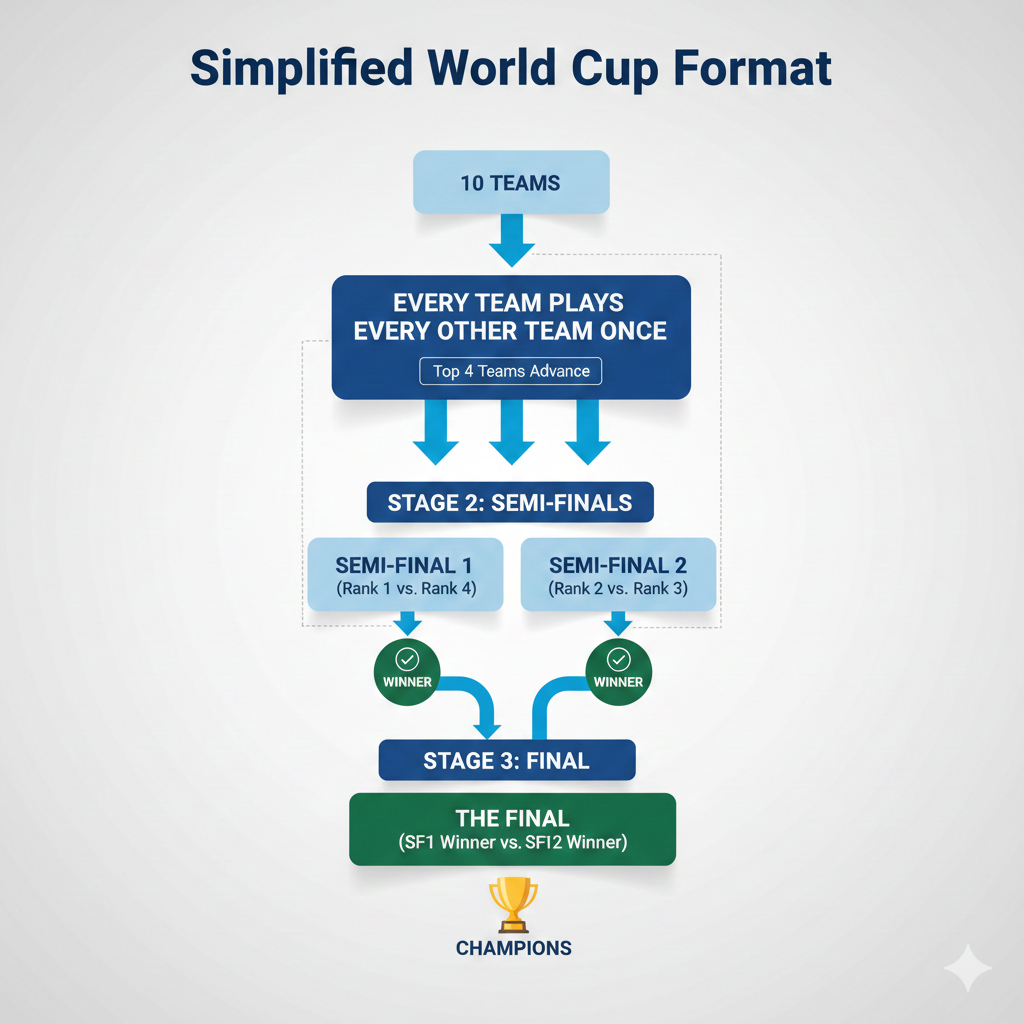
- Round Robin: This initial stage is a test of consistency, resilience, and adaptability. Teams must perform well against a variety of opponents, often in different conditions and venues.
- Semi-Finals: The top four teams from the round-robin stage advance to the semi-finals. These are high-stakes, sudden-death matches where one mistake can end a team’s World Cup dream.
- Final: The winners of the two semi-finals battle it out in the grand final, a single match that determines the world champion. The tension, drama, and emotion of the final are unparalleled.
This format ensures a prolonged period of exciting cricket, building anticipation with each passing match and culminating in a thrilling knockout stage.
3. Global Reach and Viewership: Why It’s Number One
The primary reason for the Cricket World Cup’s status as the most-watched cricket tournament lies in its immense global reach and the sheer passion of its fanbase.
Table 3.1: Estimated Viewership of Recent Cricket World Cups
| Tournament | Estimated Global Unique Viewers | Key Regions Contributing |
| 2011 World Cup | ~2.2 billion | India, Pakistan, Bangladesh, Sri Lanka, UK, Australia |
| 2015 World Cup | ~2.5 billion | India, Australia, New Zealand, UK, South Africa |
| 2019 World Cup | ~2.6 billion | India, UK, Pakistan, Bangladesh, Australia, South Africa |
Export to Sheets
Source: Various ICC, broadcast partner, and sports media reports (estimates)
Several factors contribute to these staggering viewership numbers:
- Cricket-Crazy Nations: Countries like India, Pakistan, Bangladesh, Sri Lanka, and Afghanistan, with their massive populations, treat cricket as their primary sport. A World Cup match involving their national team can bring entire nations to a standstill.
- Diaspora Audience: Large diaspora communities of these cricket-loving nations residing in countries like the UK, USA, Canada, Australia, and the UAE further amplify the viewership. They tune in, often at odd hours, to support their ancestral teams.
- Legacy Cricket Nations: Traditional cricket powerhouses such as England, Australia, New Zealand, South Africa, and West Indies have deeply ingrained cricket cultures, contributing consistently strong viewership.
- Broadcast and Digital Innovation: The ICC and its broadcast partners continually innovate, offering high-definition broadcasts, multi-language commentary, digital streaming platforms, and immersive viewing experiences, making the tournament accessible to a wider audience than ever before.
- Rivalries: The tournament ignites intense rivalries, such as India vs. Pakistan, England vs. Australia (The Ashes rivalry extended to ODIs), and Australia vs. New Zealand. These matches generate unparalleled hype and viewership.
4. Economic Impact and Sponsorship
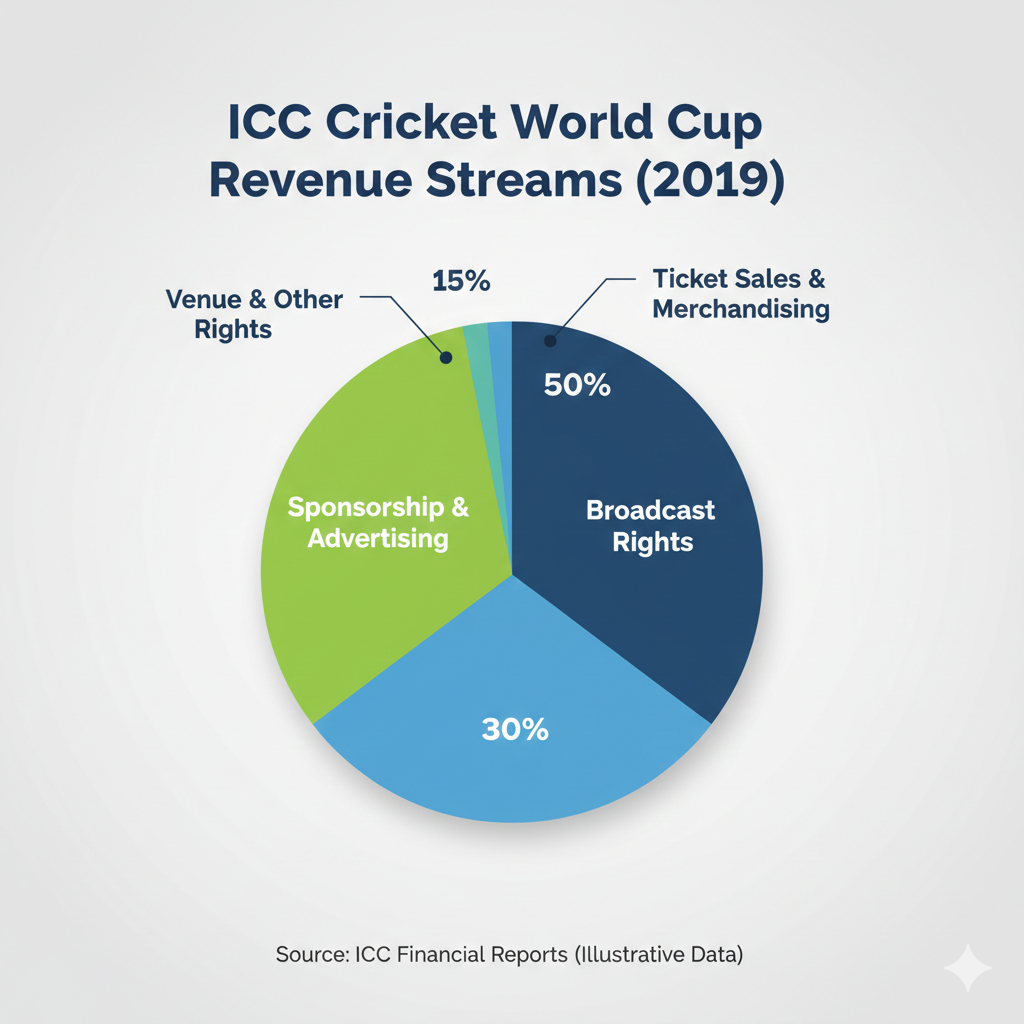
The Cricket World Cup is not just a sporting spectacle but also an economic powerhouse. Its massive viewership attracts top global brands, making it a lucrative event for the ICC, host nations, and broadcasters.
Figure 4.1: Breakdown of World Cup Revenue Streams (Illustrative)
5. The Evolution of Viewership: Breaking the Billions
The Cricket World Cup has seen exponential growth in its audience. While the 1990s focused on television sets in living rooms, the 2020s are dominated by smartphones and “peak concurrency”—the number of people watching at the exact same second.
Table 5.1: The Growth of Global Viewership
| Edition | Year | Estimated Global Reach | Peak Digital Concurrency |
| UK | 1999 | 500 Million | N/A |
| India/SL/Ban | 2011 | 900 Million | 2 Million |
| Australia/NZ | 2015 | 1.5 Billion | 15 Million |
| England/Wales | 2019 | 2.6 Billion | 25 Million |
| India | 2023 | 5.0 Billion+ (Total interactions) | 59 Million |
The 2023 World Cup in India was a “watershed” moment. By offering free streaming on mobile devices via Disney+ Hotstar, the tournament reached deep into rural areas, pushing digital viewership to nearly 60 million concurrent users during the final match between India and Australia.
6. The “India-Pakistan” Factor
You cannot talk about cricket viewership without mentioning the India vs. Pakistan rivalry. In many ways, this single match is a “tournament within a tournament.”
- Political Context: Because these two nations rarely play bilateral series due to political tensions, the World Cup is one of the few places they meet.
- Audience Surge: The 2023 clash in Ahmedabad saw a peak live concurrency of 76 million on TV and 35 million on digital platforms simultaneously.
- Global Impact: Advertisers pay up to 10 times the usual rate for a 10-second spot during this specific game compared to other group-stage matches.
Note: The India-Pakistan match consistently ranks among the most-watched sporting events globally, often rivaling the viewership of the FIFA World Cup Final in specific regions.
7. Economic Powerhouse: Impact on Host Nations
The World Cup is a massive money-maker. For the 2023 edition, the economic impact was staggering.
Table 7.1: Economic Impact of CWC 2023 (India)
| Sector | Impact (Estimated USD) | Description |
| Tourism & Travel | $861.4 Million | Hotel bookings, flights, and local transport. |
| Secondary Spending | $515.7 Million | Retail, food, and beverage outside stadiums. |
| Job Creation | 48,000+ Jobs | Full-time and part-time roles in hospitality. |
| Media Impact | $70.7 Million | City branding and global exposure for host cities. |
| Total Impact | $1.39 Billion | Total boost to the national economy. |
8. Format Evolution: From 60 Overs to 14 Teams
The ICC constantly tweaks the format to keep fans engaged while ensuring the tournament remains a “fair” test of skill.
- The 60-Over Era (1975–1983): Played in white clothes with a red ball.
- The 50-Over Shift (1987): To accommodate shorter daylight hours in the Indian sub-continent.
- The “Round Robin” Dominance: The 2019 and 2023 editions used a format where every team plays every other team. This eliminates “easy groups” and ensures the most consistent teams reach the semi-finals.
- Future Expansion (2027): The ICC has confirmed the tournament will expand to 14 teams to help grow the game in Associate nations like Nepal, the USA, and Namibia.
9. The Future of the World Cup
The ICC Cricket World Cup remains the undisputed king of cricket tournaments. While the Indian Premier League (IPL) offers more glamour and higher yearly revenue, the World Cup offers immortality.
As we look toward the 2027 World Cup in South Africa, Zimbabwe, and Namibia, the focus will shift toward sustainability and hybrid viewing (Augmented Reality stats and multi-camera angles). Cricket is no longer just a sport for the Commonwealth; with the USA and China showing increased interest, the 5 billion viewership mark is likely just the beginning.
Key Takeaways:
- India is the commercial engine of the cricket, accounting for nearly 70% of global revenue.
- Digital Streaming has overtaken traditional TV in terms of growth.
- The Format is moving back toward expansion to include more global teams.

 By
By